Monday, March 19, 2018

Gothic Architecture and Cathedrals, Week Three

So, we've finally made it to Gothic architecture. Last week, you were introduced to Romanesque architecture with Durham Cathedral with its rounded arches, lower ceilings, and a heavier, darker feel. The purpose of Romanesque was to hold the structure up. It was also a crash course in relics and reliquary.

Like any period of history, the proceeding generation thinks it is better than the last, smugly naming things regarding the previous generation, and unfortunately over time, the names stick. That's how we get the term gothic. The "enlightened" thinkers of the Renaissance looked down upon the art and architecture of the Gothic period and liked to refer to it as gothic, meaning barbaric, lacking in the higher art forms the Renaissance created.

The Gothic Period now refers to the block of time between the Romanesque Period (there is debate on when it began, but for this class, I'm going with the 6th century and overlapping a bit into the Gothic period, ending in the 12th century) and the Renaissance Period (roughly the 14th to 17th centuries). Unlike the Renaissance Period, whose art was encouraged and supported by patrons of individual talent (like Botticelli and da Vinci), artists of the Gothic Period tended to be nameless because artists of this time period were considered little better than other manual laborers. The value of their art was only in how well it expressed the Christian faith and the relationship between God and man.

So what makes Gothic architecture gothic?  This link shows the following:

  • Pointed arches
  •  ribbed vaulted ceilings
  •  slender columns
  •  the flying buttress
  •  stained glass windows
  •  ornamentation
  •  gargoyles 
  •  rose window
The purpose of Gothic architecture was to aid the pilgrim or church goer in experiencing a New Jerusalem on earth. It was light and airy, and its design was to be just as beautiful as it was functional-- a complete departure from the Romanesque. This new design was predominantly concerned with height.

When looking at Gothic architecture and art, you can't just look at one piece or one thing. It was meant to be viewed as a whole in relation to where it's placed to other items and where it's located within a cathedral. Gothic architecture aims to be a complete and comprehensive in its design. Walking through a Gothic cathedral is taking a physical walk through the Bible. An aerial view of a cathedral shows a cross, known as a cruciform or cruciformity. 

Amiens Cathedral:
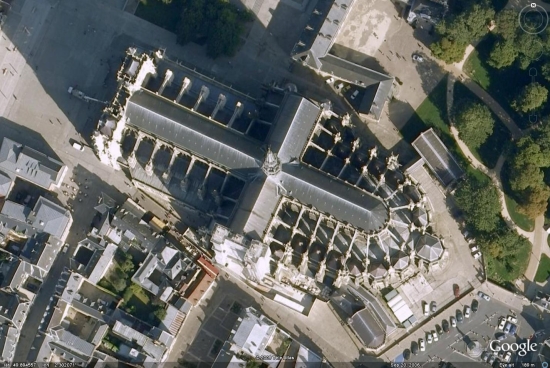

Chartres Cathedral:


York Cathedral:


The Gothic cathedral is situated like a compass. The chapels and apse (seen below) are on the east end, where the sun rises. The art and ornamentation here are the Creation. As you walk toward the transept (the north to south cross piece) the Biblical story continues through Old Testament history and prophecy. Further on toward the western end, the story moves on to the Incarnation, the Passion, and the Resurrection of Christ. As the sun sets on the western end, the sunlight filters through the Rose Window, the representation of the Final Judgment.


St. Denis was the first cathedral to leave the Romanesque behind and become the model for future Gothic cathedrals. The architecture here is known as Early Gothic of French Style/French Gothic because it originated in France. England, Germanic states, and Italy kept to the basic model of Gothic architecture but the ornamentation differed based on their own cultures.

Abbot Suger, of St. Denis, hoped to prove that France was the spiritual home of Christianity in the West. He wanted a strong partnership between the Papacy and the French monarchy. His goal was to unite the social, spiritual, and political realms in one building, this Gothic Cathedral, specifically by being the burial place for royalty. What better way to ensure importance and wealth than to offer an illustrious crypt? The St. Denis link explains more about the cathedral itself and how it tied all facets of society together.

Over the doors of St. Denis, Abbot Suger had inscribed:
Marvel not at the gold and the expense but at the craftsmanship of the work; Bright is the noble work, but, being nobly bright, the work should brighten minds, so that they may travel through the true lights, to the True Light where Christ is the true door. In what manner it be inherent in this world the golden door defines: the dull mind rises to truth through that which is material, and, in seeing this light, is resurrected from its former submersion.

This class stalled out a few times and was best shown to a bunch of 6th-8th graders by a time-lapse Minecraft video of the building of a Gothic Cathedral.

Monday, March 12, 2018

Gothic Architecture and Cathedrals, Week 2

The class made it up through Charlemagne and the year 800, but we skip forward a couple hundred years, and arrive in the 11th century. In those two hundred years, society was organized enough for people to settle down, build cities, trade was on the rise once again, and merchants were plentiful. We wrapped up the first week with a tiny blurb about pilgrimage, and that's where the second lesson picks up. Pilgrimage, as we discussed before, was one way medieval  Christians could prove their devotion to God. A pilgrimage was a physical representation of a person's search for spiritual guidance and their walk with Christ. They traveled to holy places (called shrines) where saints were buried or sacred objects were kept in order to seek penance for sins, healing, and the cleansing of the soul of the world.

Pilgrimage was big business. Along a pilgrim's journey, they needed food, accommodation, clothing, and souvenirs/badges (like people would collect on walking staffs or a more modern reference would be collectible spoons from places visited). Pilgrims carried their money on their person as there were no banks, making them susceptible to thieves. The need to protect the pilgrims along their journey gave rise to the Knights Templar, whose initial job was to police the pilgrim routes and keep them safe on their sacred journeys.

The two main destinations, of course, were Rome or Jerusalem (the Holy Land). But not everyone could afford to go so far or were not well enough in health to make the long journey. There is a map of the routes and an article covering the Cult of the Relic from Khan Academy that is fantastic. The routes were dotted with shrines, monasteries and churches to aid the pilgrim along their way.

In recent years, the British Museum housed an exhibit on relics and reliquary. These Treasures of Heaven were believed by monks and other clergy to help guide people in their knowledge and love of God. The most important relics were directly related to Christ. One of these relics is a thorn from the crown that Jesus wore. Relics were placed in reliquary. This container, as the decades passed became more ornate. This example of reliquary is from a later period than we are studying, but it shows the craftsmanship and the detail given in honor of the relic it holds.

At the monastery at Cluny, the monks did very little work, spending their time in the church, writing, singing, and performing services. These monks, led by Abbot Hugh, came mostly from noble families and were accustomed to the finer things in life. The Cluniac monks believed the arts and finest materials should be used to create a space to worship and glorify God. This emphasis on providing deeper devotion to God and encouraging pilgrimage was called Cluniac Reform.

The church building at Cluny was constructed in the Romanesque architectural style, which predates the Gothic architectural style. Work began in 1088 and continued until 1157. It may not make sense to some to go back so far before learning the Gothic architectural style, but in the coming weeks, we will see that most churches/cathedrals are built in layers. There are areas of a cathedral that will be Romanesque, or Gothic, or even the later Renaissance. The hope is to spot the differences.


Cluny Abbey set the pattern and the tone for future large scale buildings, and this link gives more information on the monks and the architecture of the Abbey. However, not all were on board with this break from a solitary, frippery-less lifestyle, for St. Bernard of Clairveaux, of a nearby monastery and a contemporary of Abbot Hugh, was not impressed with the new church building at Cluny. He declared "Oh, vanity of vanities- and foolish, too. The walls are splendid, but the poor are not there."

Now that we have the first large scale building, how do we get to a cathedral? The Christian world during the medieval period was divided into regions called 'sees' or 'diocese' for the purposes of Church government and administration. The church hierarchy from least to greatest is friar, novice, nun, abbess, monk, deacon, priest, bishop, and archbishop. Each diocese was ruled by a bishop. These bishops usually came from noble families and wealth. A cathedral was the headquarters for the bishop, coming from the Greek word 'cathedra' for throne. The bishop chose the location for a cathedral, and based his decision on the large towns or cities in his diocese, if the site had been the location of an earlier church, and particularly if the site contained holy relics or had been founded by a saint.

In terms of the pilgrimage, traveling to a location that was a large town with everything they needed in one place was huge. Their physical and spiritual needs were being met. Durham Cathedral is a prime example of Romanesque architectural style, having been founded by a saint and holding the relics of St. Cuthbert of Lindisfarne, having strategic location, and previous building structures in the Anglo-Saxon style. In England, Romanesque architecture is known as Norman or Norman Romanesque.


Romanesque architecture is heavier, as can be seen in the Durham Cathedral link above, and the light is low. The comparisons between Romanesque and Gothic architecture will continue in the next lesson.


Thursday, March 8, 2018

Poe & Pop Culture, Week Two

This week the Poe short story is The Fall of the House of Usher. You can listen to a reading of it here and the second part here.

A two minute, some seconds recap in dramatic Lego form can be found here.

This story is a classic example of Gothic literature (this link has the worst background music ever- apologies).The primary intent of a Gothic writer was to produce terror in the heart of the reader, whether dreadful anticipation of an event or the climactic event itself. It's the battle between sanity and irrationality, appearance and reality. Gothic literature in its simplest form is an examination of the dark side of human nature.

Every work of Gothic fiction draws on the setting; a crumbling castle or ancient house, mists and gloomy weather, lightning and thunder, dungeons, caves, labyrinths and long hallways, church bells in the distance... Setting is everything. You can't have the build up terror without the creeptacular location and the building to go with it. Gothic fiction, with its motifs of the supernatural and oft times sublime (and originating with Horace Walpole and his work The Castle of Otranto), is just as much about the setting as it is the plot or characters. 

Poe never gave much time to specifics, letting his silence extend the drama in the reader's mind. In many cases, he leaves the town name or character name blank, as it's not as important as what is taking place. The universes he created were often non-descript in the sense that nothing would be recognizable-- like the cities of Baltimore or Paris, or the architecture, or layout of rooms-- or familiar to the reader. He went on for pages in developing the setting but it was never done in a way to express anything a reader would feel at ease with. By removing the familiar, he created a place already uncomfortable at the beginning of the work. The unexpected and strange from the get-go started the reader off with the sense of wrong footedness.

The opening lines of The Fall of the House of Usher:
  • During the whole of a dull, dark, and soundless day in the autumn of the year, when the clouds hung oppressively low in the heavens, I had been passing alone, on horseback, through a singularly dreary tract of country, and at length found myself, as the shades of the evening drew on, within view of the melancholy House of Usher.
  • I know not how it was-- but, with he first glimpse of the building, a sense of insufferable gloom pervaded my spirit. I saw insufferable, for the feeling was unrelieved by any of that half-pleasurable, because poetic, sentiment, with which the mind usually receives even the sternest of natural images of the desolate or terrible.
  • I looked upon the scene before me-- upon a mere house, and the simple landscape features of the domain-- upon the bleak walls-- upon the vacant eye-like windows-- upon a few rank sedges-- and upon a few white trunks of decayed trees-- with utter  depression of soul which I can compare to no other earthly sensation more properly than to the after dream of the reveler upon opium-- the bitter lapse into every day life-- the hideous dropping off of the veil.
Here is the short, animated film of this story, narrated by Christopher Lee.

Think of other Gothic settings in literature: 
  • Landscape is incredibly important to the Bronte sisters.
  • Wuthering Heights by Emily Bronte, screenshots from the 1939 movie
  • Jane Eyre by Charlotte Bronte, Thornfield Hall (shot at Haddon Hall)
  • and not to leave out the other Bronte sister, The Tenant of Wildfell Hall by Anne Bronte
  • Rebecca by Daphne du Maurier and Manderly (Alfred Hitchcock's first American film, 1940)
A couple of years ago, Guillermo del Toro made a Gothic Romantic film, Crimson Peak. In the interviews, much time is spent in expounding on the use of the set, the house-- this building that is so ancient it has become sentient. The name of the house is Crimson Peak, and in many respects, the story mirrors that of the Usher family. 

The Fall of the House of Usher is just as much about the house as it is the characters. The overall feeling is there is something darker, and more wrong with the house itself and it is reflected in its inhabitants. Another element of Gothic literature is the sense of claustrophobia or confinement/ entrapment, something being locked away and help captive). As with other Gothic elements, this is both literal and figurative, being physically locked away (or buried alive in the case of Madeline Usher) or locked away in the mind. There is something terribly off in Roderick and even his friend, the narrator (because who seriously goes to someone's house to offer comfort when they don't really know the guy and while the two men languish in melancholy, Madeline dies-- or doesn't). 

Another aspect of Gothic fiction is its moral ambiguity. While the plot details highly questionable relationships and scenarios, there is always a reckoning. Gothic literature deals heavily in the concept of "sins of the father visited on the sons." There is the idea that no matter what the story is about, if it dabbles in the immoral, justice will prevail and there will be consequences for the sin. The narrator in The Fall of the House of Usher describes the family "... the stem of the Usher race, all time-honored as it was, had put forth, at no period, any enduring branch; in other words, that the entire family lay in the direct line of descent, and had always, with very trifling and very temporary variation, so lain." Several essays on this piece suggest that the family tree did not, in fact, branch out. *cough* They kept family in the family. *cough* This was not a completely removed facet of society, considering the royals and their bloodlines (Queen Victoria and her lineage and offspring, any one?) of that time period and their ignorance of the rules of consanguinity. Even Poe married his young cousin, so who's to question the details of this fiction. That being said, it is clear that in the case of Roderick and Madeline Usher, the sins catch up to them literally (they both die and the biological line dies with them) and figuratively (the family estate crumbles to ruin). The anticipation of terror is urged on by the characters themselves because they know intrinsically there will be a judgment.


Poe and Gothic Fiction continues next week with the works The Cask of Amontillado and The Masque of the Red Death.

There's also been some conversation about the influence of Poe on Lemony Snicket. This link shows a load of literary references that include Poe. The bigger question being what literary work is not referenced?


Monday, March 5, 2018

Gothic Architecture and Cathedrals, Week One

In all my years of studying history, Gothic cathedrals have always ranked fairly high in my interests. Travel and personal experience in these environs have only made it better (or worse if you find yourself awkwardly in a long, rambling conversation with me about cathedrals because that's just not normal conversation fodder). I've always imagined teaching a class such as this to high school level students, but the need arose to adapt it to a younger age group. After the first class, it has the potential to be fabulous or the weirdest class my group of 6th to 8th graders have taken up to this point. I had some terrible technical difficulties which resulted in a horrifically drawn map of medieval Europe on a white board. My mapping skills include loosely labeled blobs in the vaguest set of generalities known to man. I doubt the kids will forget my mad skills any time soon.

That being said, the question for any study of history is where to begin. History is not just a bland listing of facts. It has layers. Much like ogres and onions. Donkey and Shrek may have been speaking of emotions but I've always felt the conversation could have really been about the study of history. I can't hold history to such a serious, academic nature all the time, so you get a Shrek link, because, frankly, history can be the worst. So, I went hardcore and presented 800 years of history in one class. Bless their hearts. 

When we talk about centuries, we say, for example "the 6th century" and you would think that means the 600s, but it doesn't. It was all the dates in the 500s. The 400s are all the 5th century,  all the 700s are the 8th century, etc. I still have to stop and think about it after all these years. For this class, the majority of the 11th and 12th centuries are the Gothic architecture years, so the 1000s and the 1100s. However, we start before year 100 AD and the the Apostle Paul. To explain the world view of the Middle Ages (500-1500 AD), you have to go back a bit. The Bible was the most influential writing of this time period. The foundation of medieval theology are the letters of Paul and a life lived by faith, which is necessary to a Christian life. A good chunk of the background of this class came from this book: 

The basic constructs of medieval life were faith (letters of Paul), civic duty (Romans 13:1-6), an attitude towards women that was subordinate and yet recognized as of great importance to the community, and that both the New Testament and Old Testament were of equal importance; being the complete story of Christ: the times leading to his birth, his life, and then after death. Paul made the connection between the Old and New Testaments in Romans 5:12-16. Medieval people believed Jesus came as the "second Adam" and since there was no Mrs. Jesus medieval scholars made Mary the "second Eve," the giver of the life of Jesus as Eve was the giver of life. The book of Hebrews presents Jesus as a Priest and a King which was a staple for medieval Christian theology.

The second greatest influence on medieval culture was ancient Greece, specifically Plato and Aristotle. This is called "classicism" and it is part of medieval life in art, literature, philosophy, and theology. Plato's works were about "the idea of life" and "the experience of life" follows the thoughts of Aristotle. This is where I modified the class for the younger age level. There's no way to adequately explain the importance of Greek thought and the scholasticism that evolved from this combining of Christian faith to produce the worldview that pervaded the Middle Ages. It is important to note because later on the great Gothic cathedrals were given inspiration by the scholars of that time, which were predominantly monks. 

Now the time line picks up, and we gallop foreword in history.

303AD: Diocletian is the Roman emperor. He was concerned that his subjects were more loyal to their Christian faith than they were to him. It is under his rule that the most severe persecutions of Christians took place. 
  • Martyrdom and Sainthood: according to dictionary.com, the basic definition of a martyr is "a person who willingly suffers death rather than renounce his or her religion." The most revered saints of the Catholic church were martyred in this period: LucyMargaret, Vincent and Sebastian. These martyrs were given a special status to be remembered. They were made saints; those who are in heaven and eternally in God's favor. Later on when persecution ended, sainthood was extended to those who had lived an exemplary Christian life. This class of sainthood was called "confessors."
306-337AD: Constantine becomes emperor and he recognizes that Diocletian's persecution of the church did not help unify the empire. He believes that unifying the church will help unify his lands under his rule.

313AD: Constantine establishes the Edict of Milan making Sundays as holidays, exempting the clergy from government service, and because he was an all around great guy, he eliminated the branding of the face as punishment because humans are made in the image of God. He also gave property and buildings to the church.

325AD: Constantine saw these things helped in unifying his empire, but it just wasn't quite as organized or successful as he had hoped. He decided that in order for the church to help him, he needed to help the church. He called together the First Ecumenical Council where Constantine and the church leaders put together a statement of core beliefs that was called the Nicene Creed

Over the following years, Constantine's sponsorship of Christianity let to it's spread across the empire and beyond. Constantine declared Christianity the only legal religion, going so far as to restrict military and civic service to Christians. 
 
391AD: Theodosius becomes the first emperor to persecute heretics.Problem: If you can't get a job unless you are a professing Christian and now it's illegal to be anything but Christian, do you think some of those people simply became "Christian" just to live peacefully? As Christianity spread, it took on bits and pieces of pagan religion- like our holidays of Easter and Christmas have a pagan origin- and later on we will be discussing Gothic architecture in Ireland, where we will see a slightly different take than continental Europe. 

Now that Christianity is now "safe" and "unified" how does medieval life change? They now have time to *cough* pontificate.

Persecution no longer exists, so how does a person prove how far they are willing to go for Christ?

In 251AD, a man named Antony was born and he took the parable of the rich man and went extreme. He adhered to a Christian version of asceticism, a vigorous self-denial of worldly pleasures, which was sometimes viewed as a kind of "daily martyrdom." This lifestyle demanded its members to remove themselves from society to devote themselves to Christ's service, which began as simply seeking God in his word, but grew over hundreds of years to becoming scholars, educators, setting up hospitals, and other charity work. Men went to monasteries and women went to nunneries.

520AD: St. Benedict of Nursia drew up detailed rules for monks and organized the lives of those who lived in monasteries for the next 500 years. He set out to make sure monks spent their days efficiently and did not become lazy or bored, believing this led man away from God. This day in the life of a Benedictine monk blew the minds of kids in class. So. Much. Church... according to my 6th to 8th grade boys.

So now, Christianity is organized, the empire is organized, and now the monasteries are helping organize medieval life on the community level. People can live and move about, and where they go, Christianity goes with them. 

768-814AD: Charlemagne has arrived, conquering most of the western Christian continental Europe. His concept of Christian empire was him at the head, using a combination of education and religious uniformity, which is often referred to as the Carolingian Renaissance, making his reign the most important in medieval history.

Charlemagne was a highly educated man for that time, deeply committed to the study of theology and learning. He encouraged monasteries to become places of learning. He believed that living a well ordered life was good, but education only made life better.

Everything we have covered here is the foundation of medieval culture. The church was used for good (and not so good) to give the society structure. Once again, for those that did not choose a monastic or nun lifestyle, the question once again became how is a person supposed to prove their devotion to Christ? One way was for them to set out on a pilgrimage. Many people hoped that making a journey like that would bring them forgiveness for their sins or heal them of their afflictions. A pilgrimage was a physical representation of a person's search for spiritual guidance. They journeyed to holy places where saints were buried or where sacred objects/relics were kept. The vessels that contained the relics are called reliquary, and more often than not, they were kept in monasteries. 

A famous bit of literature dedicated to the concept of the pilgrimage was The Canterbury Tales.

As pilgrimages increased, the places were reliquary were kept needed to be open and available to large numbers of people and the space for church goers to partake in the sacred rite. This kind of building needed to be separate from the monasteries so as not to interfere with that lifestyle. From this we get the church building before it became a cathedral. 

Thursday, March 1, 2018

Poe & Pop Culture, Week One

Eight weeks to teach a course on Poe and Pop Culture... it's been a brilliant idea from the beginning and yet less cohesive the more time I spent with it. Primarily a literature class, I expected a bit of reading and multi-media interaction... until the multi-media part crashed and burned in the worst way on this first day of class. Awkwardness is not my thing. This was acute awkwardness. Hmmm, how to fill the time, and then get the links to my students. Oh, hey! A blog. Boom. Nice, tidy links to go with the lecture portion of the class, because who wants all lecture and no play?

I set out to read this in preparing for the class:
And while this was way more than I will ever need, it gave me a bit more insight into his legacy. 
This class is a bit of a survey class, and to sum up his life, it was one misery after the next manifested itself in his poetic dirges. The most basic summary of his life I gleaned from this (hey, I have young children):
                                       
Poe was born in Boston January 19, 1809, to parents who were stage actors parents, his mother more accomplished and popular than his father, who, after too many negative reviews on his performances turned to heavy drinking and he eventually left the family. Then the misery set in. Basically, every woman he ever loved in any sense died: his mother, his foster mother, and his wife all died of Tuberculosis or as that era called it "consumption". One of his brothers also died from TB. Another mother figure in his younger years died of a brain tumor. 

While Poe never made much of a living off his writing, he was as an editor and critic of other writers, garnering the nickname "Tomahawk Man" for his scathing reviews. He made few friends among the literary crowd, but readers of his reviews loved him. Among his works, Poe wrote essays on how to write. Specifically, he wrote an essay (The Philosophy of Composition on how he wrote The Raven in which he states his philosophy is: Beauty is the sole legitimate province of the poem... Melancholy is thus the most legitimate of all poetical tomes... the death then, of a beautiful woman is unquestionably the most poetical topic in the world-- and equally it is beyond doubt that the lips best suited for such topic are those of a bereaved lover.

That sums up Poe right there. Class dismissed. Except for the patterns found later on stemming from his influence. Walt Disney anyone? It's a much better story the mother figure is removed from the story line.

His personal life stayed in disarray and shambles until his end when he was found outside a tavern and completely mad in the head. He was taken to a nearby hospital, but never recovered, dying on  October 7, 1849. Problem was that he left his legacy in the hands of Rufus Griswold, someone who was not happy with the reviews he had received from Poe. It's not really known what kind of man Poe really was. Griswold succeeded in his postmortem smear campaign against Poe, making him out to be the vilest of men, lascivious, drunken, drugged, and as psychotic as the characters Poe wrote about. Poe's American popularity waned quickly, but European interest seems to have been steadfast, especially the French and English readership. It took nearly a hundred years and several biographers before Poe was once again back in the graces of American literary genius.

Classified as a writer in the literary era of Romanticism, Poe maintained a vastly different way of writing than most of his contemporaries. His writings are generally categorized in the sub genre of Gothic fiction, combining romance, horror, the supernatural with the intent to freak the reader out. Elements of Gothic fiction are 1) the virginal maiden, 2) older, foolish woman, 3) hero, 4) tyrant/villain, 5) bandits/ruffians, and 6) clergy. I envision the animated Disney film "Robin Hood" as the archetypal Gothic story. Hollywood made bank in its early days with tales like this starring Errol Flynn and Tyrone Power

Gothic fiction predates Poe by a couple of decades, but he certainly holds a place in their ranks. The most famous works of Gothic fiction being Mary Shelley's Frankenstein (published 1818), A Christmas Carol (Charles Dickens, 1843), Dracula (Bram Stoker, 1897), Les Miserables (Victor Hugo, 1862), The Mysteries of Udolfo (Ann Radcliff, 1794), Jane Eyre (Charlotte Bronte, 1847), and Northanger Abbey (Jane Austen, 1890). Typically, the male writers wrote from the perspective of "sensibility" also referred to as the "cult of sensibility," which features female characters who were prone to weeping, fainting, needing the use of smelling salts, having reactionary fits of pique, women as genteel characters that need excessive pandering, etc. Female writers, on the other hand, (like Bronte and Austen) used these sensibilities to give female characters power as they used the sensibilities as a staged weakness. Mrs. Bennet from Pride and Prejudice is a fabulous example of the fainting woman character ( and Austen is brilliant in her jibe against those who write female characters as damsels in distress by making Mrs. Bennet ridiculous).

Poe, in many ways, is the literary gift that keeps on giving. Arthur Conan Doyle (author of Sherlock Holmes which was inspired by Poe's The Murders in the Rue Morgue) stated at an event celebrating the 100th year after Poe's death: These tales have been so pregnant with suggestion, so stimulating to the minds of others, that it may be said of many of them that each is a root from which a whole literature has developed. 

The next seven weeks of classes are focusing on his short stories, and not much will be covered in regards to his poetry. We briefly mentioned The Raven, Annabel Lee, and The Bells. Here are some links that give a modern take on these poems, some are readings and others animated clips.

The Raven
Annabel Lee


Each class has bits of multimedia, emphasis will be on Vincent Price, Basil Rathbone, and Christopher Lee.

Bonus Material:


Thursday, December 7, 2017

The Beginning: December 7, 1941

"Yesterday, on December 7th, 1941- a date which will live in infamy- the United States of America was suddenly and deliberately attacked by naval and air forces of the Empire of Japan..." and with those words Franklin D. Roosevelt began his speech to the American people. It was short, to the point, no flowery words; a listing of the deeds perpetrated at Oahu, other locations in Hawaii, and islands throughout the Pacific. This speech is remembered for those first few words, and every year, for over seven decades, this one line has become synonymous with the date. However, it is the end of the speech that has always grabbed my attention most. "Always will we remember the character of the onslaught against us.
No matter how long it may take us to overcome this premeditated invasion, the American people in their righteous might will win through to absolute victory.
I believe I interpret the will of the Congress and of the people when I assert that we will not only defend ourselves to the uttermost, but will make very certain that this form of treachery shall never endanger us again.
Hostilities exist. There is no blinking at the fact that our people, our territory and our interests are in grave danger.
With confidence in our armed forces - with the unbounding determination of our people - we will gain the inevitable triumph - so help us God.
I ask that the Congress declare that since the unprovoked and dastardly attack by Japan on Sunday, Dec. 7, a state of war has existed between the United States and the Japanese empire.This moment was so much more than a remembrance of an invasion and the destruction, it was the beginning.


I often consider the vast discrepancies in maturity and the drive toward goals this "Greatest Generation" has with the following generations. My Grandad was a young teenager at the time of the attack on Pearl Harbor. It was a couple more years before he could sign up with the Navy, his parents going with him to co-sign because he was still at minor. He was stationed in the Pacific, specifically Hawaii. At seventeen, he was convicted of his need to be part of the war.


I don't know much about what he did or where he went. Like most of this generation, he was quiet on this subject and I never felt comfortable asking questions. There are two photos of this time, one with him and buddy (he's on the left in the photo below) and another with a Hawaiian girl in a grass skirt and a bikini top (which the memory is hazy and seems a bit mythical because no one talked about that one, especially Grandma... and that photo has suspiciously disappeared to time). There is a beauty in the naivete in wanting to be part of something, to be patriotic, to go to war, to be brave, and then there is the devastating reality. Few stories were shared with his family. There's the one where he lost a month's pay for trying his hand at Black Jack and losing spectacularly, so much that he refused to even touch a deck of cards for the rest of his life, and there's the one told many times, with resounding clarity, of the time he found he was allergic to pineapple and experienced a nasty case of hives. He was told that if it happened again, he would be sent home. The allure of bravery having faded in the face of what was real, he went to a pineapple field and waded in it, hoping for the hives. I never could picture my incredibly skinny, six foot, two inch Grandad rolling around in pineapples-- and how do you 'wade' in pineapples?--, but I always felt his desperation in the story when he told it. The story always ended with sigh, those pineapples didn't work a second time around. He never got the hives. He never got to go home.


Pearl Harbor was a starting point. It brought the United States into a multi-front war, with casualties totaling over one million American lives. So when this day rolls around every year, I see it as more than just the event of the Japanese invasion of Hawaii. I see it's impact and consequences weaving down through the generations, including mine.

Thursday, August 17, 2017

Ordinary Folk

"It was the best of times, it was the worst of times, it was the age of wisdom, it was the age of foolishness, it was the epoch of belief, it was the epoch of incredulity, it was the season of Light, it was the season of Darkness, it was the spring of hope, it was the winter of despair..." 
~Charles Dickens, 1849. 

Over the course of the last twenty years or so, in what I can assume would be the summation of my 'adult' life, there has been a pattern of growing complacency tempered severely with outrage in regards to the world at large; disunity, terrorism, fear, apathy... a jumbled juxtaposition of life, often oxymoronic in its particulars. It seems that many believe that we are living in extraordinary times, that we consider social contentions and striking out as some novel idea simply because we are living it now. There is considerable arrogance in assuming that what we face as a nation or as part of a global community is unique to us because it's happening NOW... that we are somehow more educated, more philosophical, more tolerant, more broad minded than any previous generation. I've pondered quite a bit recently on what others have said about the adversities they faced. And here you go:

William Wilberforce (1759-1833) spent twenty years campaigning against the British slave trade, the story of hundreds of years of putrid conditions and the foulest of sins
against human beings. 

"To live our lives and miss that great purpose we were designed to accomplish is truly a sin. It is inconceivable that we could be bored in a world with so much wrong to tackle, so much ignorance to reach and so much misery we could alleviate."

"I am disturbed when I see the majority of so-called Christians having such little understanding of the real nature of the faith they profess. Faith is a subject of such importance that we should not ignore it because of the distractions or the hectic pace of our lives."


"I mean not to accuse any one, but to take the shame upon myself, in common, indeed, with the whole parliament of Great Britain, for having suffered this horrid trade to be carried on under their authority. We are all guilty—we ought all to plead guilty, and not to exculpate ourselves by throwing the blame on others; and I therefore deprecate every kind of reflection against the various descriptions of people who are more immediately involved in this wretched business."


"Is it not the great end of religion, and, in particular, the glory of Christianity, to extinguish the malignant passions; to curb the violence, to control the appetites, and to smooth the asperities of man; to make us compassionate and kind, and forgiving one to another; to make us good husbands, good fathers, good friends; and to render us active and useful in the discharge of the relative social and civil duties?"


Elie Wiesel (1928-2016), Nobel Laureate and Holocaust survivor. The way this history is bandied about these days as a means to an end in arguing both for and against whatever a party stands for, I'll leave it to Mr. Wiesel.

"The opposite of love is not hate, it's indifference. The opposite of beauty is not ugliness, it's indifference. The opposite of faith is not heresy, it's indifference. And the opposite of life is not death, but indifference between life and death."

"... if we forget, we are guilty, we are accomplices... We must always take sides. Neutrality helps the oppressor never the victim. Silence encourages the tormentor, never the tormented. Sometimes we must interfere... When human lives are endangered, when human dignity is in jeopardy, national borders and sensitivities become irrelevant. Wherever men or women are persecuted because of their race, religion, or political views, that place must- at that moment- become the center of the universe."

"My greatest disappointment is that I believe that those of us who went through the war and tried to write about it, about their experience, became messengers. We have given the message, and nothing changed."


Simon Wiesenthal (1908-2005), Holocaust survivor.

"For me the Holocaust was not only a Jewish tragedy, but also a human tragedy. After the war, when I saw that the Jews were talking only about the tragedy of six million Jews, I sent letters to Jewish organizations asking them to talk also about the millions of others who were persecuted with us together - many of them only because they helped Jews."

"Hatred can be nurtured anywhere, idealism can be perverted into sadism anywhere. If hatred and sadism combine with modern technology the inferno could erupt anew anywhere."

"The history of man is the history of crimes, and history can repeat. So information is a defence. Through this we can build, we must build, a defence against repetition."

"There were millions of such families anxious only for peace and quiet in their own little nests. These were the mounting blocks by which the criminals climbed to power and kept it."

"For your benefit, learn from our tragedy. It is not a written law that the next victims must be Jews. It can also be other people."


Dietrich Bonhoeffer (1908-1945), theologian and anti-Nazi dissident who lost his life for his beliefs and outspokenness.

"Silence in the face of evil is itself evil: God will not hold us guiltless. Not to speak is to speak. Not to act is to act."

"Christianity stands or falls with its revolutionary protest against violence, arbitrariness, and pride of power, and with its plea for the weak. Christians are doing too little to make these points clear... Christendom adjusts itself far too easily to the worship of power. Christians should give more offense, shock the world far more, than they are doing now."

"We must finally stop appealing to theology to justify our reserved silence about what the state is doing -- for that is nothing but fear. 'Open your mouth for the one who is voiceless' -- for who in the church today still remembers that that is the least of the Bible's demands in times such as these?"

"We are not to simply bandage the wounds of victims beneath the wheels of injustice, we are to drive a spoke into the wheel itself."


Sir Winston Churchill (1874-1965), former British Prime Minister.

"Courage is what it takes to stand up and speak; courage is always what it takes to sit down and listen."

"An appeaser is one who feeds a crocodile, hoping it will eat him last."


Martin Luther King, Jr. (1929-1968), minister and civil rights activist

"Nonviolence means avoiding not only the external and physical violence but also internal violence of spirit. You not only refuse to shoot a man, but you refuse to hate him."

“The ultimate measure of a man is not where he stands in moments of comfort and convenience, but where he stands at times of challenge and controversy.”

"Nothing in the world is more dangerous that sincere ignorance and conscientious stupidity."


A couple more: Mr. Rogers and J.R.R Tolkien