Wednesday, April 11, 2018

Gothic Architecture and Cathedrals, Week Five

This week we wrapped up French Gothic and dabbled in another medieval construct that shows up in early the early Gothic period. The last French cathedral in this study is the cathedral found in Amiens, ranking as the tallest completed cathedral in France, standing at 138.8 feet. The Beauvais cathedral is taller, but is incomplete.


As with previous cathedrals, there is a relic associated with this structure. It is said the head of John the Baptist was found in the ruins of a palace in Constantinople during the Fourth Crusade and brought to Amiens. During the French Revolution, the relic was removed, and while it was commanded to be buried in a cemetery, it was housed with the mayor of the town. It was returned to the cathedral in 1816.

During the construction, the builders were uncertain on the placement of the buttresses and placed them too high to counteract the force of the ceiling, causing structural defects. Other buttresses were later added to assist in holding up the load.

Other points of interest for this cathedral:
  • The largest medieval interior in Western Europe 


  • the famous "weeping angel" (not the Doctor Who variety but the chubby cherubim)


  • And the World War One memorials commemorating those who perished at the Battles of the Somme


More details from the class and the cathedral can be found here.

A fantastic video by drone of the interior of Amiens can be found here. The constructs of Gothic architecture are on fabulous display.

The last structure in our Gothic architecture study is not a cathedral (the seat of a Bishop). It is St. Chappelle and it is in the heart of Paris, specifically the royal palace complex. Louis IX (1214-1270 AD), and later canonized in 1297 as St. Louis, was king of France. He had two primary interests: his collection of Passion relics (of Jesus' entry into Jerusalem to his crucifixion and death) and solidifying his power through his patronage of the arts and architecture in France. At the time, the emperor in Constantinople, the head of the church in the East, could enter the Hagia Sophia through The Emperor Door, his own personal entrance. Louis IX wanted this same convenience and a place to house his Passion relic collection. Among his collection were the Holy Crown of Thorns and a fragment of the cross of Christ. He believed with his possession of the Crown of Thorns and Gothic chapel to house it, he would be unequivocally be the central monarch of Western Christendom. (This is all grossly simplified and I feel I'm leaving out pertinent information, but the reminder here is that it's a class of 6th-8th graders.)

St. Chappelle represents the height of Gothic architecture and is known as the rayonnant style, focusing a thinner look a a brighter, wider space for displaying the stained glass. As you can see, the basic constructs are there: ribbed vaults, pointed arches, stained glass; but it lighter, more delicate than previously found in Gothic architecture.


For more information and in depth detail on the chapel, watch the video here.

And to walk through St. Chappelle with Rick Steves, watch the video here.


We've spent quite a bit of time discussing the purpose of the monks, the pilgrimage, the shrines and relics, and the cathedrals-- all part of this need to have a physical representation of the the spiritual journey. In early Gothic architecture, a labyrinth was utilized to represent this journey. Unlike a maze where you have a choice of right or left, there is only one way to go in a labyrinth. The mystery of the labyrinth is long and fabled, but it represents the idea of a beginning and an end along a varied and meditative walk. In the Chartres and Amiens cathedrals, the builders inlaid in the floor a labyrinth where the nave and the transept cross. 

Chartres Cathedral Labyrint:


Amiens Cathedral Labyrinth:


For those artistic types, here's a video on how to draw the Chartres labyrinth.


This week we move across the English Channel and take up the Gothic there.


Thursday, April 5, 2018

Poe & Pop Culture, Week Five

On October 15, 2009, a six year old boy allegedly was aboard a helium filled gas weather balloon that had blown away from its moorings, floating away into the atmosphere. The media went crazy, reporting the boy and balloon were traveling at 7000 feet, going a distance beyond fifty miles from where it started in Fort Collins, CO. This was breaking news, gaining worldwide attention as viewers watched the balloon fly across the Colorado landscape, hoping the boy would land safely. #balloonboy was trending on Twitter, all eyes were on the sky. The balloon finally landed some twelve miles from Denver Airport where it was discovered there was no boy on board. Frantic, the manpower and media exposure reached epic proportions in the search for the missing boy. Falcon Heene was found hiding in his parents' attic where he told officials he was "hiding for the show." The Heene parents were taken to court, found guilty of this hoax and tying up resources, were fined, and spent some time in jail.

This is far from the first time a hoax of this magnitude hit the air waves/television broadcast/print. In August 2015, The Guardian produced a Top Ten List of the greatest literary hoaxes. "Literary hoaxes run the gamut of grey areas from misread satires, outright frauds, misappropriated material, and works yet more mysterious..." Poe's The Balloon-Hoax (1844) was listed at number three with this write up: "Poe’s 1844 article for The New York Sun is exemplary of the recursive and proliferating nature of hoaxes. This story, claiming to detail the first trans-Atlantic balloon-crossing accomplished by the explorer Monck Mason (based on the actual balloonist Thomas Monck Mason), may have been conceived in reaction to the Great Moon Hoax published in the same paper nine years earlier, claiming that the astronomer John Herschel had observed winged humanoids on the moon with a radically new and powerful telescope. Poe felt that this hoax report had plagiarised his own short story ‘The Unparalleled Adventures of One Hans Pfaall’. To further complicate matters of actuality, Poe’s hoax may have inspired Jules Verne’s Around the World in 80 Days."

Poe, himself, was quite pleased with the reaction to his piece. He used real people, realistic elements. He is said to have remarked "I never witnessed more intense excitement to get possession of a newspaper." One of he less successful stories, he later felt The Sun profited from the writing and he was no rightly compensated.

 A few other frauds/hoaxes from the list by The Guardian are:

  • Jonathan Swift- Predictions for the Year 1708 (1708): Writing as the fictional astrologer Isaac Bickerstaff, Jonathan Swift forecast the death of the astrologer John Partridge from a “raging fever” in a pamphlet entitled Predictions for the Year 1708. Partridge responded with a denial but on the day predicted, 29 March, ‘Bickerstaff’ followed up his speculation with a black-framed poetic Elegy and a pamphlet confirming Partridge’s death, The Accomplishment of the First of Mr Bickerstaff’s Predictions, apparently authored by an anonymous employee of ‘the Revenue’. Despite repeated denials, Partridge was reportedly plagued by those who insisted he had died.
  • Theodore Sturgeon- I, Libertine (1956): In the 1950s US bestseller lists were compiled by newspaper subeditors who would phone around bookstores to ask what was selling. The late night talk radio host Jean Shepherd, in collusion with his listeners, concocted a fake book, I Libertine, a raunchy historical romance by the similarly fictitious author Frederick R. Ewing, a retired Royal Naval officer resident in Rhodesia and expert in eighteenth century erotica. Shepherd urged his listeners to request the title from as many bookshops as possible. Despite its non-existence it was banned in Boston before the publisher Ballantine commissioned Kurt Vonnegut’s friend (and character in Slaughterhouse 5) Theodore Sturgeon to make the hoax text a reality.
  • Clifford Irving- Autobiography of Howard Hughes (1971): In 1970 the novelist Clifford Irving and his friend Richard Suskind cooked up a plan to write the ‘autobiography’ of Howard Hughes, who had completely withdrawn from public life since the late 1950s. Irving had form in these grey areas, having written a biography of the Hungarian art forger Elmyr de Hory entitled Fake! (1969). Forging documents bearing Hughes’s signature, Irving and Suskind secured large advances before being rumbled post-publication when the reclusive Hughes gave a press conference. Irving served 17 months for fraud. His story was featured in Orson Welles’s final film F for Fake! and he gave his own version of events in his book The Hoax (1981), made into a film starring Richard Gere.
  • Benjamin Wilkomirski- Fragments: Memories of a Childhood, 1939-1948 (1996): A case study in trauma narratives, Fragments told the story of Wilkormiski’s childhood experience of the Holocaust as a prisoner in the concentration camps at Majdanek and Auschwitz. Sent to interview Wilkomirski for a Swiss magazine, the journalist Daniel Granzfried, whose own father had been interned at Auschwitz, had doubts about Wilkormiski’s story. Granzfried discovered that the author had in fact been only four at the close of the war and living in comfort with adoptive parents in Zurich. Even as his publisher pulped his book and sympathised with his ‘damaged’ state of mind, Wilkormiski refused to accept the evidence of his untruths.

As we've moved into the section of Poe concerning Science Fiction, it's only right that we include one the better known hoax stories (unintentional, though it was) of the adapted to radio story of War of the Worlds written by H.G. Wells in 1898. Airing on Halloween night, October 30, 1938, the hour long drama, directed and produced by up and coming Orson Welles at Mercury Theater, with a script by Howard E. Koch, unexpectedly became an event no one would forget. Presented as a series of news bulletins that seemingly interrupted the regular programming, the first half of the drama went on for thirty minutes without any breaks. For the many people who missed the first few minutes, they were unaware that this was not actually happening. The "breaking news" of the drama reported explosions on Mars and eventually a Martian invasion of New Jersey. The panic and devastation of "first hand accounts" built up the terror in the listeners, as the alien invasion quickly moved west, encompassing the whole of the United States. By the time the first half concluded, the damage had been done. 

To listen to the broadcast, click here. 


Those who tuned in and were convinced Martians had invaded the United States hit the telephones, desperate for information from the telephone operators (before any type of emergency services, all emergency calls were fielded through an operator). AT&T interviewed several operators in the 1980's about their experiences that night in October 1938. It can be seen here. 

The next day, Orson Welles was called to a press conference by CBS, and took questions from the press:
  • Question: Were you aware of the terror such a broadcast would stir up? Answer: Definitely not. The technique I used was not original with me. It was not even new. I anticipated nothing unusual.                                
  • Question: Should you have toned down the language of drama? Answer: No, you don't play murder in soft words.
Orson Welles did make a statement and apologized to the public. 

The fallout is disputed to this day in regards to how many listeners it actually caused to panic. It's one of those things lost to time and conjecture. It attained enough hype, however, to have Hitler comment on it a few days later on November 8, 1938, in Munich. He saw the effect on the American people as "the corrupt condition and decadent state of affairs in democracy."

H.G. Wells, author of The War of the Worlds, did meet Orson Wells once on October 28, 1940. To hear the interview and their comments about their mutual drama, click here. 

We continue Poe and Science Fiction next week with The Unparalleled Adventure of One Hans Pfaall. This story is not in the book we are using, but as it's public domain, can be read at that link.


Wednesday, April 4, 2018

Gothic Architecture and Cathedrals, Week Four

As we have studied to this point, the Gothic style originates in France. This is the French Gothic or Early Gothic as we saw at St. Denis. Continuing down the timeline in the French Gothic style, we arrive at Chartres. Like most French words, there are more letters than actually said aloud. Most say "Chart" with a soft sh sound in place of the ch, others pronounce it "Chartre" with the soft sh and an accent on the e, and sometimes you get the American version of sounding out every syllable, "Chartres" with the sh and the es on the end. Here's an example of the pronunciation. I've always felt that it was quite rude to Americanize a pronunciation of place or a person simply because we can't be bothered to learn it the way it was meant.

So, Chartres. This location in France was a destination of pilgrimage. The shrine there housed three relics that were highly revered: the Well of the Strong Saints, the Sancta Camisia, and the head of Anna, the mother of Mary. 
  • The Well of the Strong Saints: the place where it is believed the bodies of early Christian martyrs were dumped

  • The Sancta Camisia: the tunic Mary supposedly wore when she gave birth to Jesus. Legend states (but is more than likely a fantastic story, yet untrue) that Charlemagne gifted this relic to Chartres.


  • The head of Anna: it is alleged this head was found in Constantinople during the Fourth Crusade by Louis, Count of Blois, and grandson to Louis XII. It is unclear where this relic is now, but it made Chartres a destination of a Marian pilgrimage, emphasizing the adoration the Virgin Mary and her mother, Anna. As the cathedral was built, many facets of the the artistry in the stained glass and sculpture were dedicated to the two women. The veneration of Mary and Anna are seen throughout France and is generally noted with the terms Notre Dame in conjunction with the cathedral name. Here, it is Notre Dame de Chartres. The Notre Dame that we are most familiar with (as in The Hunchback of Notre Dame) is Notre Dame de Paris, indicating it housed Marian relics and its location. It has a long and varied history, and now it houses Passion (the time period from the triumphal entry of Jesus into Jerusalem to his crucifixion) reliquary from a nearby chapel that we touch on later. This is a a sculpture of Anna, holding baby Mary, and it's located on the north porch of Chartres.


To view the cathedral and its location, click here for Rick Steve's walk through.

Engineering the Gothic Cathedral is truly a wonder and defies many ideas of what we have concerning the other name for this period: The Dark Ages. I've mentioned before the medieval need for order and their overwhelming interest in ancient Greece and Rome. Using the geometry of the ancient Greeks, the architects of the Gothic were able push the vertical limits of building. National Geographic explains here. Additional information on the concept of Sacred Geometry can be found here

The cathedral at Chartres was early in the Gothic standard. The flying buttresses, specifically, are much sturdier and heavier in appearance, and not the finer, more elegant versions we see later on. The importance of the flying buttresses and how they allowed the ceiling to rise can be seen here. They replaced the heavy, load-bearing walls. For more information than most people would normally desire, here's a full 18 minutes of a walk through, which I broke up for my 6th-8th graders out of a sense of self preservation.

We will continue with French Gothic this week with Amiens Cathedral and St. Chappelle.


Poe & Pop Culture, Week Four

It occurred to me that I neglected to post lasts weeks lesson notes and links and didn't post them. Here they are in all their brief glory.

The readings for this week were Island of the Fay and Hop Frog. For those that want to do the readings, most all of Poe's works are public domain and can be found with a simple google search. Most of them are also available via audio and I usually post the youtube link in these posts. However, very little can be found for these two pieces on youtube. Now, back to it. In retrospect, the first reading was poorly chosen-- I assigned it, and then regretted it immensely when I realized it wasn't quite what I had in mind for class cohesiveness. The Island of the Fay suggests that it's a fantasy that stars the fay (fairies), but, no. It's one of Poe's essays where he waxes eloquent as he contemplates the world at large. He starts out talking about music and then goes on a trip to light fantastic. Very little is actually written about this piece. I found one blog where the writer suggests it was steeped in allegory.

  1. The Island is the earth.
  2. The Fay are human beings; even though fay or fae generally refer to fairies.
  3. The Fay make one trip around the island experiencing all four seasons; what we would view as the seasons of life. 
So, there you have it... we read one of his essays. I'm not sure where my brain was at in thinking this went with the lesson. The kids agreed. 

Now, to the real lesson and what I had intended. Hop Frog or The Eight Chained Ourang-Outangs. Up to this point, we have focused on Poe's legacy of Gothic horror fiction, what he is preeminently known for.  We rounded off that discussion with Vincent Price and Tim Burton, and now we are headed into Science Fiction. Poe is many times considered the Father of Science Fiction. In his collection of short stories, we find Hop Frog, not one of his better known works, but the setting and feel has that AU (alternate universe) feel. The main character is Hop Frog, a dwarf that had been taken captive and made the king's jester. There was another dwarf captive that served the king and her name was Trippetta. The king was a foolish, loud man who adored his wine, lavish parties, and tyranny. The king received his comeuppance at a grand party of tomfoolery. And, like all Poe, the antagonists met a foul end. The literary trope being the little man triumphing over his oppressors in the style of literary irony: what happens is the opposite of the expectation.

This short story brought to mind Hans Christian Andersen's The Emperor's New Clothes (where the fool is made the fool) and this scene from Chitty Chitty Bang Bang (when the king of Bulgaria is fooled by the childish fun of his two new "dolls" and the children capture the kind, queen, and nobles).

As we transition to science fiction, it's only fair to begin with a contemporary writer who from his younger years was influenced immensely by Poe, specifically the story of Hop Frog. Neil Gaiman (hands down one of the best writers in modern times) has an impressive cache of literature: DC Comics Black Orchid series, DC Comics The Sandman (his greatest achievement in the comics realm), a two part Batman story for DC in 2009, his novels: Neverwhere, American Gods, Anansi Boys, Stardust, The Graveyard Book, The Ocean at the End of the Lane, and Coraline, there are also a plethora of short stories (ranging from children to YA to adult), for film and television he wrote or cowrote: Beowolf, Stardust, Coraline, two episodes of Doctor Who in 2011, "The Doctor's Wife" and "Nightmare in Silver," and American Gods has recently been produced as a series, and two of his works, Neverwhere and Good Omens (his collaboration with Terry Pratchett) were produced as radio programs. My personal plug here is for the BBC's production of Neverwhere (which you can get on Audible or iBooks-- sorry, no links here because the BBC protects their products voraciously) and stars James MacAvoy, Natalie Dormer, Benedict Cumberbatch, Anthony Steward Head, Christopher Lee, Bernard Cribbins, and Romola Garai among others, including Neil Gaiman, himself. It is a work of art that must be perused at length.

Gaiman has written of his love of Poe in an article found on his website and also in this interview. In both, Gaiman expresses the absolute need to read Poe out loud, as it becomes a vastly different experience. In this class, the goal has been to read the work, listen to the work, and then, where possible to see how he has been interpreted in various forms. In the interview, Gaiman mentions how Poe had originally thought the bird to utter "Nevermore" should have been a parrot. Can you even imagine that? The Raven it must be. This is reference in one of my favorite cartoons Ruby Gloom, and an entire episode is dedicated to a time traveling raven named Poe and a parrot named Paco. The episode, "Time Flies," in its entirety can be found here.

Gaiman describes Poe as "vain, envious, good-hearted, morbid, troubled, and a dreamer, and he sums up Poe's legacy in this, "Still, Poe, for all his short life and unfulfilled potential, remains today, his finest stories as successful, as readable, as contemporary as anyone would desire. Fashions in dead authors come and go, but Poe is, I would wager, beyond fashion."


Readings for this week are The Domain of Arnheim and The Balloon Hoax.

Monday, March 19, 2018

Poe & Pop Culture, Week Three

This was a relatively laid back class this week. The students had read The Cask of Amontillado and The Masque of the Red Death which wrapped up Gothic fiction/horror for this course. Between these two classes, I'm about GOTHIC-ed out, and I have found it a bit difficult to switch from 6th-8th grade Gothic Architecture and Cathedrals to 9th-12th grade Poe in the space of about ten minutes. That being said, here are my notes and links for the third week of Poe and bringing the Gothic portion to a close.

So. The Cask of Amontillado. Just your basic, bury someone in your crypt alive story, and even then it was determined that this short story really wasn't as terrifying as others Poe offerings we've read. Here's the Playmobil recap.  For extra viewing, here is the Basil Rathbone reading.

In the case of The Masque of the Red Death, my mad youtube skills failed. Most links were, quite frankly, disturbing-- more so than even I'm comfortable with. One of my children walked by as I was watching an animated version and she said "WHAT are you watching?" Oh, you know, just your typical animated blood fest. Here is a reading by Basil Rathbone. Bottom line for the moral of this story is you can't get away from Death. There's no hiding from it. Of course, I'd prefer less blood, but Poe... and if you are desperate to know how to make movie blood, a staple for the Gothic genre, here's Mark Gatiss (of Sherlock and Doctor Who fame and self proclaimed aficionado of the macabre) making perfectly tasty blood, otherwise known as Kensington Gore.

In the 1960s, Poe seemed to peak in some weird, campy popularity that seems incredibly, well... 1960s. An actor in particular, a Mr. Vincent Price, adored Poe and the macabre. In 1944, he starred in one of my favorite film noirs Laura and followed with villainous roles in House of Wax (1953) and The Fly (1959), garnering him the status of preeminent villain in all his Gothic/horror contrived glory. Under the direction of Roger Corman, he was cast in Poe stories:

It should be said here that the screenwriters somehow stretched these short stories into full length films with varying degrees of success. 

In 1970, Price was filmed in An Evening of Edgar Allan Poe, which showed him in a lavish dining room, with campy Gothic overtones (shocking, I know) and reciting the works The Tell-Tale Heart, The Sphinx, The Cask of Amontillado, and The Pit and the Pendulum. Given the sheer volume of Poe works Price made, it would be safe to say he was a fan.

Price's last feature film was Edward Scissorhands (1990), where he suffered his final film death as the inventor. Tim Burton was delighted to have Price in this film, and had already used the gruesome talents of Price several years before when Burton brought together his brand of creepy, with Poe, and the talents of Price. In 1982, Burton made a short film called Vincent, which referenced Poe's The Raven and was narrated by Price. This short film can be found at the link above or on the bonus features of The Nightmare Before Christmas.

Bringing the Gothic to a close, and moving beyond the morbid, the class watched the episode of The Muppets that starred Vincent Price. All tenants of Gothic fiction/horror are parodied and otherwise made palatable in these final clips:

Due to Spring Break, class continues next week with the stories Hop-Frog and The Island of the Fay.

Gothic Architecture and Cathedrals, Week Three

So, we've finally made it to Gothic architecture. Last week, you were introduced to Romanesque architecture with Durham Cathedral with its rounded arches, lower ceilings, and a heavier, darker feel. The purpose of Romanesque was to hold the structure up. It was also a crash course in relics and reliquary.

Like any period of history, the proceeding generation thinks it is better than the last, smugly naming things regarding the previous generation, and unfortunately over time, the names stick. That's how we get the term gothic. The "enlightened" thinkers of the Renaissance looked down upon the art and architecture of the Gothic period and liked to refer to it as gothic, meaning barbaric, lacking in the higher art forms the Renaissance created.

The Gothic Period now refers to the block of time between the Romanesque Period (there is debate on when it began, but for this class, I'm going with the 6th century and overlapping a bit into the Gothic period, ending in the 12th century) and the Renaissance Period (roughly the 14th to 17th centuries). Unlike the Renaissance Period, whose art was encouraged and supported by patrons of individual talent (like Botticelli and da Vinci), artists of the Gothic Period tended to be nameless because artists of this time period were considered little better than other manual laborers. The value of their art was only in how well it expressed the Christian faith and the relationship between God and man.

So what makes Gothic architecture gothic?  This link shows the following:

  • Pointed arches
  •  ribbed vaulted ceilings
  •  slender columns
  •  the flying buttress
  •  stained glass windows
  •  ornamentation
  •  gargoyles 
  •  rose window
The purpose of Gothic architecture was to aid the pilgrim or church goer in experiencing a New Jerusalem on earth. It was light and airy, and its design was to be just as beautiful as it was functional-- a complete departure from the Romanesque. This new design was predominantly concerned with height.

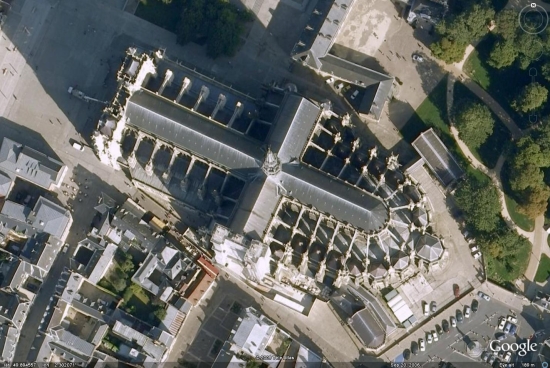
When looking at Gothic architecture and art, you can't just look at one piece or one thing. It was meant to be viewed as a whole in relation to where it's placed to other items and where it's located within a cathedral. Gothic architecture aims to be a complete and comprehensive in its design. Walking through a Gothic cathedral is taking a physical walk through the Bible. An aerial view of a cathedral shows a cross, known as a cruciform or cruciformity. 

Amiens Cathedral:


Chartres Cathedral:


York Cathedral:


The Gothic cathedral is situated like a compass. The chapels and apse (seen below) are on the east end, where the sun rises. The art and ornamentation here are the Creation. As you walk toward the transept (the north to south cross piece) the Biblical story continues through Old Testament history and prophecy. Further on toward the western end, the story moves on to the Incarnation, the Passion, and the Resurrection of Christ. As the sun sets on the western end, the sunlight filters through the Rose Window, the representation of the Final Judgment.


St. Denis was the first cathedral to leave the Romanesque behind and become the model for future Gothic cathedrals. The architecture here is known as Early Gothic of French Style/French Gothic because it originated in France. England, Germanic states, and Italy kept to the basic model of Gothic architecture but the ornamentation differed based on their own cultures.

Abbot Suger, of St. Denis, hoped to prove that France was the spiritual home of Christianity in the West. He wanted a strong partnership between the Papacy and the French monarchy. His goal was to unite the social, spiritual, and political realms in one building, this Gothic Cathedral, specifically by being the burial place for royalty. What better way to ensure importance and wealth than to offer an illustrious crypt? The St. Denis link explains more about the cathedral itself and how it tied all facets of society together.

Over the doors of St. Denis, Abbot Suger had inscribed:
Marvel not at the gold and the expense but at the craftsmanship of the work; Bright is the noble work, but, being nobly bright, the work should brighten minds, so that they may travel through the true lights, to the True Light where Christ is the true door. In what manner it be inherent in this world the golden door defines: the dull mind rises to truth through that which is material, and, in seeing this light, is resurrected from its former submersion.

This class stalled out a few times and was best shown to a bunch of 6th-8th graders by a time-lapse Minecraft video of the building of a Gothic Cathedral.

Monday, March 12, 2018

Gothic Architecture and Cathedrals, Week 2

The class made it up through Charlemagne and the year 800, but we skip forward a couple hundred years, and arrive in the 11th century. In those two hundred years, society was organized enough for people to settle down, build cities, trade was on the rise once again, and merchants were plentiful. We wrapped up the first week with a tiny blurb about pilgrimage, and that's where the second lesson picks up. Pilgrimage, as we discussed before, was one way medieval  Christians could prove their devotion to God. A pilgrimage was a physical representation of a person's search for spiritual guidance and their walk with Christ. They traveled to holy places (called shrines) where saints were buried or sacred objects were kept in order to seek penance for sins, healing, and the cleansing of the soul of the world.

Pilgrimage was big business. Along a pilgrim's journey, they needed food, accommodation, clothing, and souvenirs/badges (like people would collect on walking staffs or a more modern reference would be collectible spoons from places visited). Pilgrims carried their money on their person as there were no banks, making them susceptible to thieves. The need to protect the pilgrims along their journey gave rise to the Knights Templar, whose initial job was to police the pilgrim routes and keep them safe on their sacred journeys.

The two main destinations, of course, were Rome or Jerusalem (the Holy Land). But not everyone could afford to go so far or were not well enough in health to make the long journey. There is a map of the routes and an article covering the Cult of the Relic from Khan Academy that is fantastic. The routes were dotted with shrines, monasteries and churches to aid the pilgrim along their way.

In recent years, the British Museum housed an exhibit on relics and reliquary. These Treasures of Heaven were believed by monks and other clergy to help guide people in their knowledge and love of God. The most important relics were directly related to Christ. One of these relics is a thorn from the crown that Jesus wore. Relics were placed in reliquary. This container, as the decades passed became more ornate. This example of reliquary is from a later period than we are studying, but it shows the craftsmanship and the detail given in honor of the relic it holds.

At the monastery at Cluny, the monks did very little work, spending their time in the church, writing, singing, and performing services. These monks, led by Abbot Hugh, came mostly from noble families and were accustomed to the finer things in life. The Cluniac monks believed the arts and finest materials should be used to create a space to worship and glorify God. This emphasis on providing deeper devotion to God and encouraging pilgrimage was called Cluniac Reform.

The church building at Cluny was constructed in the Romanesque architectural style, which predates the Gothic architectural style. Work began in 1088 and continued until 1157. It may not make sense to some to go back so far before learning the Gothic architectural style, but in the coming weeks, we will see that most churches/cathedrals are built in layers. There are areas of a cathedral that will be Romanesque, or Gothic, or even the later Renaissance. The hope is to spot the differences.


Cluny Abbey set the pattern and the tone for future large scale buildings, and this link gives more information on the monks and the architecture of the Abbey. However, not all were on board with this break from a solitary, frippery-less lifestyle, for St. Bernard of Clairveaux, of a nearby monastery and a contemporary of Abbot Hugh, was not impressed with the new church building at Cluny. He declared "Oh, vanity of vanities- and foolish, too. The walls are splendid, but the poor are not there."

Now that we have the first large scale building, how do we get to a cathedral? The Christian world during the medieval period was divided into regions called 'sees' or 'diocese' for the purposes of Church government and administration. The church hierarchy from least to greatest is friar, novice, nun, abbess, monk, deacon, priest, bishop, and archbishop. Each diocese was ruled by a bishop. These bishops usually came from noble families and wealth. A cathedral was the headquarters for the bishop, coming from the Greek word 'cathedra' for throne. The bishop chose the location for a cathedral, and based his decision on the large towns or cities in his diocese, if the site had been the location of an earlier church, and particularly if the site contained holy relics or had been founded by a saint.

In terms of the pilgrimage, traveling to a location that was a large town with everything they needed in one place was huge. Their physical and spiritual needs were being met. Durham Cathedral is a prime example of Romanesque architectural style, having been founded by a saint and holding the relics of St. Cuthbert of Lindisfarne, having strategic location, and previous building structures in the Anglo-Saxon style. In England, Romanesque architecture is known as Norman or Norman Romanesque.


Romanesque architecture is heavier, as can be seen in the Durham Cathedral link above, and the light is low. The comparisons between Romanesque and Gothic architecture will continue in the next lesson.