Monday, May 6, 2019

The Third Reich & The Holocaust, Week Eight: Liberation, Trials, & Aftermath

Over the course of this semester, our study of the Holocaust began with a Band of Brothers clip of the liberation of Dachau. At the time, I wanted to get the feel of seeing the camps for the first time like those Americans did and then grow the class around how it happened, why, the legacy of the holocaust. This first clip, is mostly stuff we've covered but puts it firmly into our timeline here at the end.

What is the Holocaust Part 7/7: Perfecting Industrial Murder (1942-1945)

As the Allies move east, and the Soviets move west, the camps were liberated. So the question of "Now what?" moves through the masses of displaced people.

Holocaust Survivors: First Steps in the DP Camps and New Beginnings

After liberation and the end of the war, Germany was divided up by the Allies, but what happened to the leaders of the Nazis? The Nuremberg Trials.

What Happened at the Nuremberg Trials?

One of the largest areas of academic study of the Holocaust is human healing, memory, and the roles people played in the inception of Nazi ideology to genocide. There are two terms that came with this study in regards to Germans and Nazis: collective guilt versus individual responsibility. Many times history is just as guilty of handing out judgement based on culture and ethnicity as the Nazis or other groups that categorize broadly. The collective guilt in reference to this section of history says that no matter what role a German played-- perpetrator or bystander or even actively resistant-- the guilt belongs to society as a whole. Individual responsibility leaves it to what it says, the individual. But the problem many faced was a marshland of accusations-- some claiming they were resistant to save face or coming out against Nazism after its fall. Typically, most historians fall back on collective guilt in regards to the Holocaust-- whether "fair" or not. I can see the merits of both trains of thought, but in this aftermath, it was clear that shame and guilt should be applied broadly to make sure it never happened again. I think of the moment when Eisenhower forced the citizens of towns near concentration camps to walk through the terrors, to witness the bleakness of humanity's lowest point. It was unfathomable to suggest that these people had no idea what was happening.

These photos are of the Memorial to the Murdered Jews of Europe, located in Berlin, Germany. It is designed to look orderly, but once you move into the blocks, it becomes disorientating.The further in you walk, the taller the blocks become giving you the feeling that you are lost within order. 


As a result of assigning collective guilt, the shame of the Holocaust has come down through the descendants of the perpetrators and the victims, casting a shadow even today.

How Germany Grapples with its Dark Nazi Past

The Third Reich and the Holocaust are part of the German conscience today. This next clip is of Flula Borg on the Conan Show. We began the clip at 0:50 and watched to the end. It's interesting to see how the taint of that history stays with the younger generations. This clip is from last summer.

Flula Borg's Favorite Action Film is Die Hard- Conan on TBS

We made it to the end. We've spent time on the details, on the human elements, and the infinite number of why's. What do we do with this information? Should we do anything with it? Antisemitism and Nazism are not dead. Genocide is rampant around the world, and neo-Nazism is on the rise.

Elie Wiesel, the author of this semester's book closes the class out.

Elie Wiesel: Universal Lessons


Modern Euro 2, Week Eight: End of the War & Aftermath

Timeline:

1945


  • 17 January: Soviets push west and take Warsaw
  • 26 January: Soviets liberate Auschwitz
  • 4-14 February: Yalta Conference
  • 13-14 February: Dresden firebombing/firestorm
  • 7 March: Allies take Cologne
  • April: Allies find stolen art in salt mines
  • 12 April: President Roosevelt dies in office; Truman becomes President of the US
  • 16 April: Battle of Berlin begins; Americans enter Nuremberg
  • 28 April: Mussolini captured and hanged by Italian bipartisans
  • 30 April: Hitler commits suicide
  • 2 May: German troops in Italy surrender
  • 7 May: unconditional German surrender
  • 8 May: VE (Victory in Europe) Day
  • 5 June: Allies divide Germany and Berlin
  • 16 July: atomic bomb test; Potsdam Conference
  • 6 August: atomic bomb dropped on Hiroshima
  • 8 August: Soviet invasion of Manchuria and declaration of war against Japan
  • 9 August: atomic bomb dropped on Nagasaki
  • 14 August: unconditional Japanese surrender
  • 2 September: VJ (Victory over Japan) Day
Other dates:

  • 5 March 1946: Iron Curtain
  • 13 August 1961 to 9 November 1989: The Berlin Wall
Timeline: Cities at War- Berlin -- We watched minutes 41:10 to 48:45. This clip shows the battle of Berlin and the civilian population versus the Soviets. The battles of the Eastern Front were markedly more violent than those of the Western Front, as the two cultures, ideologies, and politics were a stark contrast. Also the Soviets firmly put forth the "turn about fair play" concept-- what Nazi Germany did to the Soviets would be equalled if not worse. 

Modern day Berlin still shows the leftover scars of street battles.


The end of the war came-- 8 May 1945-- but then what? The beginning of a new power struggle and the continuing war of ideologies. The Cold War.

It seems apropos to end two semesters of Modern European History with links from Indie Neidell, who brought us many of the concepts I used.

Zero Hour: Origins of the Cold War


The Reichstag was left in ruins following the war and fell into disuse. Restorations were made after the reunification in 1990,  and the cupola was an addition that is modern in concept. As you walk up the inside of the glass cupola, the idea is that the German government is transparent and the people are above the government; you can look down into Parliament from above.


And we go out with a bang-- if only Monty Python was born decades earlier we could have avoided this mess. Monty Python's Funniest Joke in the World

Additional links:

Footage of pictures taken during WW2 and superimposed on current photos-- I've found these to be fascinating; to see the greatness and the tragedy of war over the life that is today. Then and Now- WW2 Edition.

I briefly mentioned in the time line the stolen art that was found in the salt mines. I highly recommend the movie Monuments Men, a film that depicts the story of the Allied unit of men send out to find and make safe the art of the world. 


Sunday, April 21, 2019

The Third Reich & the Holocaust: German Resistance and Complicity

Let's Kill Hitler

I've waited months to use that clip. This class is so very heavy most of the time. We can always use a TARDIS.

Any way, the notes are a bit shy this week as well as link heavy.

Nazi Germany- The Underground Resistance

Among the Resistors was the brother/sister team of Hans and Sophie Scholl who made their anti-Nazi efforts at the University of Munich. This book about their lives was written by their sister, Inge Scholl. The link takes you to the book listing on Amazon. The White Rose, Munich 1942-1943

The White Rose is clip that sums up their efforts and the loss of their lives.

History File Nazi Germany: Opposition to Hitler. We viewed minutes 17:05 to 20:14.

For further reading, check out Germany's Underground: The Anti-Nazi Resistance by Allen Welsh Dulles.

While civilians were involved in various actions against the Nazis, the war dragged on and many in the Germany military were disillusioned of Hitler, and began planning Hitler's downfall.

The most well known assassination attempt was called the July Plot and was carried out by Claus von Stauffenberg. Real Valkyrie details the event. And you're welcome to those who remember Walter Cronkite. Operation Valkyrie was the contingency plan if anything were to happen to Hitler and the government thrown into an emergency. The hope was that after the death of Hitler, this plan would go into action, and the new leaders would end Nazi rule and the war.

There is a movie that stars Tom Cruise as von Stauffenberg called Valkyrie.

When speaking of the Resistance, we must also bring to light complicity. Studying Nazis and the Holocaust, if anything, begs some organization... a way to classify. Not that we should do this absolutely, but we are human. We know there were Nazis who were purely aligned with the Nazi ideology, Nazis in name, civilians who joined, civilians who abstained-- the bystanders. We know who the victims are, but how do we classify who was a perpetrator? Was it the ones who did the planning and the carrying out of the genocide? Was it those neighbors who turned in their Jewish neighbors? Can we lay blame on those who saw and yet did nothing? And what about the role of the clergy and the churches in Germany?

It's that last question we discussed in class. The role of the clergy and the church. This documentary is not my usual fodder, but put out by a group I've referenced many times over the last several months. It's Theologians Under Hitler which highlights the teachings of "Christian" Nazi enthusiasts... those who used their authority in the pulpit to justify the Holocaust and used their positions to back up Nazi policy and the Final Solution. This documentary specifically details Gerhard Kittel, Paul Althaus, and Emanuel Hirsch. We watched minutes 42:06 to 48:47 and 51:36 to 55:49.

On the flip side of the clergy that propagated Nazi ideology, we have Dietrich Bonhoeffer and Martin Niemöller. There is a fabulous biography by Eric Metaxas, Bonhoeffer: Pastor, Martyr, Prophet, Spy. Youtube is chalk full of interviews with Metaxas on Bonhoeffer. The clip here, Dietrich Bonhoeffer: Anti-Nazi Resistant and Resolute Hero, is Metaxas speaking.

Martin Niemöller was and is a controversial man. In his early days, he was pro Nazi and joined the party. As the party changed and became more antisemitic than Niemöller was comfortable with, he began speaking out against the Nazi party. Subsequently, he was arrested and interned at Dachau and Sachsenhausen from 1938 to 1945. He was in a separate section of the camps. He survived his incarceration and died in 1984, aged 92. Shortly after the war ended in 1945, he initiated the "Stuttgart Declaration of Guilt" that collectively apologized for the church's role in  Nazism and the Holocaust. So soon after the war made this statement highly controversial as it read like the Treaty of Versailles with its "war guilt clause." Niemöller is most famous for this poem:

First they came for the Socialist, and I did not speak out--
Because I was not a Socialist.
Then they came for the trade unionists, and I did not speak out--
Because I was not a trade unionist.
Then they came for the Jews, and I did not speak out--
Because I was not a Jew.
Then they came for me--and there was no one left to speak for me. 

This link is to an article titled "Church Complicity: Changing Views on German Churches and the Holocaust" found on the United States Holocaust Memorial Museum website. 


Modern Euro 2, Week Seven: Allies Begin Liberation of France & Oradour-sur-Glane

Timeline:

1944

  • 27 January: Siege of Leningrad ends
  • 5 June: Allies enter Rome
  • 6 June: D-Day landings
  • 10 June: Oradour-sur-Glane massacre
  • 20 July: Valkyrie
  • 19 August: Resistance uprising in Paris
  • 25 August: Liberation of Paris
  • 13 September: Allies reach the Siegfried Line
  • 17 September: Operation Market Garden
  • 14 October: Allies liberate Athens; Rommel commits suicide
  • 4 December: civil war in Greece
  • 16 December- 25 January: Battle of the Bulge
We are nearing the end of the this class, so many things have been condensed. The campaign in Italy continues, and the Allies are preparing for their first major western front offensive, Operation Overlord and the Normandy invasion. 

On 19 August 1942, Allied forces landed on the beaches of Dieppe, on the German occupied, French northern coast. This small scale invasion was to be temporary-- go in, gather intelligence, stir up the Germans, and then withdraw. This, however, was unsuccessful, garnering 1,400 deaths and 1,946 captured. 

The Dieppe Raid, narrated by Alex Trebek-- which seems odd, but the majority of the Allied forces in this raid were from Canada, and Trebek also hails from Canada, details the raid and the events that made it unsuccessful. 

Why would this be important now that we are studying two years later? This failed landing and invasion prompted better tactics and logistics of Operation Overlord and D-Day.

The invasion of Normandy was a massive undertaking that took an incredible amount of deception, like we saw with Operation Mincemeat last week, and planning. This elaborate operation to convince the Germans that an attack should be expected at Pas de Calais began directly across the English Channel from Pas de Calais in Kent, England.  Operation Bodyguard was the ultimate in pulling the wool over German eyes. 

For Operation Bodyguard and Fortitude information and the ideas for Hobard's Funnies like the Mulberry Harbours, we watched minutes 11:43 to 20:43 of WWII in HD Colour: Overlord, Part 9/13.

The stage was set, intelligence indicated that the foolery had worked and while the Wehrmacht prepared for an invasion at Pas de Calais, the Allies were ready to land on the beaches of Normandy.


The first phase of Operation Overlord was codenamed Operation Neptune which was the beach invasion portion of Overlord. It would become the largest seaborne operation in history. The aerial bombardment was codenamed Operation Pointblank. The generals overseeing these operations were General Dwight D. Eisenhower and Bernard Montgomery (who we spoke about a few weeks ago from the North African campaigns with Rommel). There were five beaches used in the landings: Utah, Omaha, Gold, Juno, and Sword. 

Another aspect of the planning was the use of parachute troops behind enemy lines in Normandy. 13,000 troops parachuted, but the most famous of these is the D-Day jumped landings of the 101st Airborne, "Easy Company"-- or as many would recognize today as the "Band of Brothers." Their job was to slow down the German response to the Allied beach invasion. Many missed their drop zones, but once they regrouped, they struck. Lt. Dick Winters lead a few meant to capture and destroy four German 105mm funs at Utah Beach and then the next day helped take the town of Carentan from the Germans. 

This clip-- Band of Brothers- D-Day Jump Scene-- is from the miniseries "Band of Brothers". We did not watch the entire scene, just long enough to get an idea of what an airborne drop in the midst of an invasion would be like. 

After D-Day, Easy Company was pulled back to England before regrouping and being part of Operation Market Garden, and ill conceived attempt to capture bridges over the Rhine River, opening up routes to Berlin. Although considered a bust, Easy Company kept this operation from being an outright disaster. 

For further reading, check out All the Way to Berlin by James Megallas, an officer of the 82nd Airborne, who after fighting at Anzio in the Italian campaign, jumped at Operation Market Garden before making the push to Berlin. The link will take you to Amazon.

On 10 June 1944, four days following the Normandy invasion, the 2nd Waffen-SS Panzer division was sent to Oradour-Our-Glane, in what has been speculated as either a German retaliation for French Resistance's part in Operation Overlord for sabotage, or as the clip suggests, a hostage operation gone wrong somewhere. To be clear, this is the Waffen-SS which is not part of the German Wehrmacht but a unit under the Nazis. 

The Oradour-sur-Glane Tragedy was the massacre and destruction of the entire town. USHMM.org records this event as the "tragedy [that] rivaled the liquidation at Lidice as an iconic symbol of German crimes against civilians in occupied Europe." The town of Lidice was liquidated exactly two years earlier on 10 June 1942 in retaliation for the assassination of Reinhard Heydrich, spoken about in class last week.


After the unsuccessful Operation Market Garden and the massive push across France, the Allies were ragged and exhausted. Hitler took his chance and attacked, which began the Battle of the Bulge. 

The Battle of the Bulge (1944-1945) was located, once again in the Ardennes forests which had seen action in the First World War and with the German invasion of France in 1940. 

We did not get to this clip in class, but it is of the experience of the Band of Brothers battling in foxholes in Bastogne. Band of Brothers: Battle of the Bulge

Films for today's section are Saving Private Ryan and the miniseries Band of Brothers. Both are exceptional accounts of events in France and the push to Berlin. However, they are exceedingly realistic at times and should be viewed with discretion. 


Tuesday, April 16, 2019

The Third Reich and the Holocaust: Camp Systems, Wannsee Conference, & the Final Solution

Timeline:

1942
  • 20 January: Wannsee Conference
  • April: US creates Japanese-American Internment Camps
  • 27 May- 6 June: Heydrich Assassination
  • June: mass murder of Jews by gas begins at Auschwitz
  • 10 June: Nazis liquidate Lidice in reprisal for Heydrich's death
  • 17 December: British Foreign Secretary Eden tells the British House of Commons of mass executions of Jews by Nazis; US declares the crimes will be avenged
Today's main reference source is www.ushmm.org, the official site of the United States Holocaust Memorial Museum (USHMM) in Washington, D.C., and a phenomenal resource in this type of study.

The Wannsee Conference was attended and lead by SS General Reinhard Heydrich, Gestapo Commander Heinrich Müller, and SS Chief of Jewish Affairs Adolf Eichmann. The goal of this meeting was to answer the "Jewish Question." According to USHMM, it was "to inform and secure support from government ministries and other interested agencies relevant to the implementation of the Final Solution," and "to disclose to the participants that Hitler himself had tasked Heydrich and the RHSA with coordinating the operation." The Final Solution held the fate of some 11 million Jews in German occupied Europe.

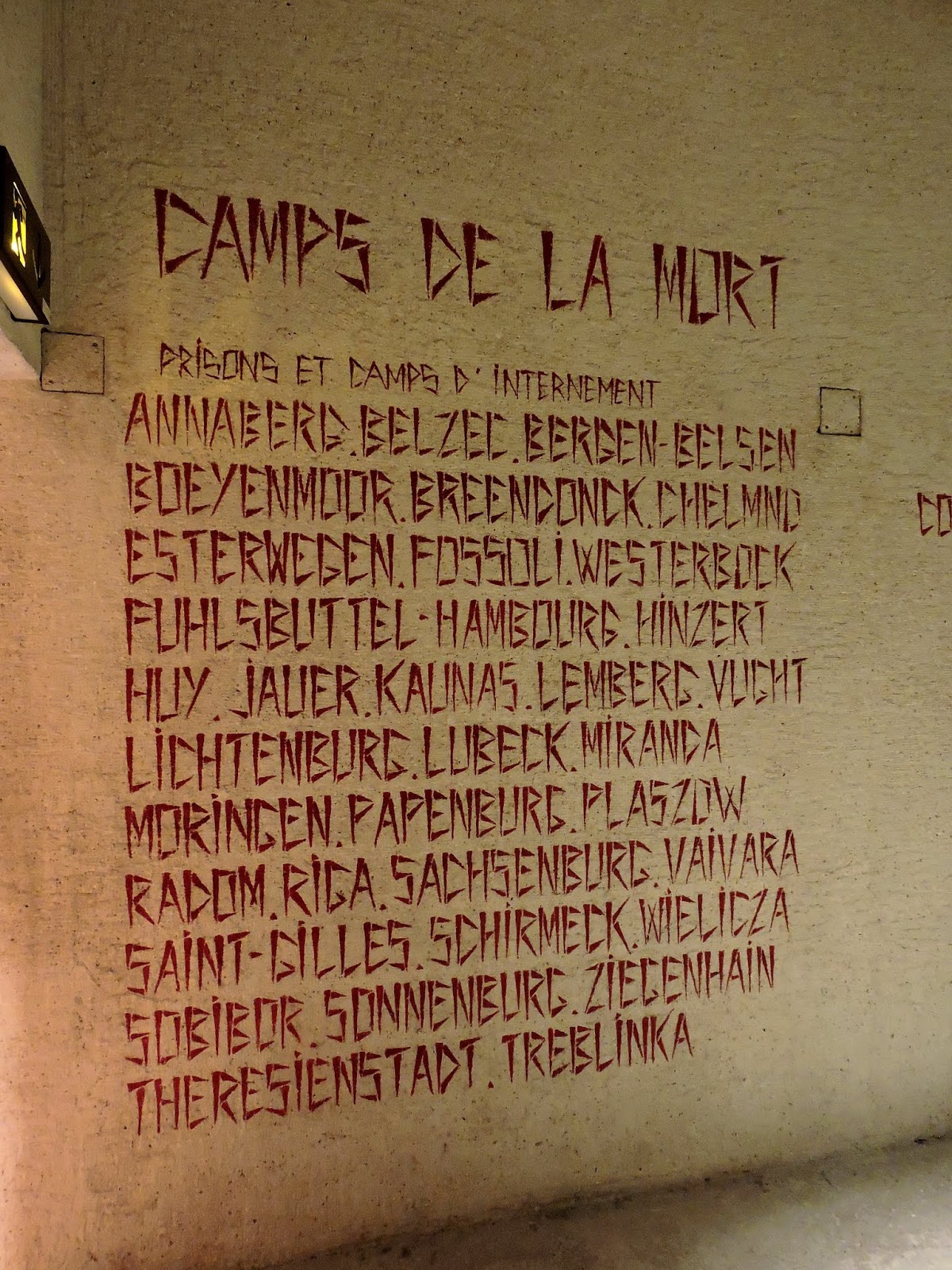
In Paris, on the Ile de la Cité-- an island in the Seine River and the medieval settlement of Paris, there on the Notre Dame end of the island is a small memorial to the victims of the Holocaust. As we talked about last week, France had many active roles in the Holocaust: perpetrators, bystanders, resistance, rescue, etc. The inner walls of this memorial have the most provocative design: the names of the all the camps of the Holocaust in red upon a cream colored wall. We only know of the most famous camps-- Auschwitz, Treblinka, Dachau, Birkenau-- but there were thousands. For every major camp, there are dozens of sub camps, all dedicated to concentration, labor, and death.

We started last class with the camp system and the beginnings of the Final Solution.

Key Historical Concepts in Holocaust Education: Nazi Camps
 
This link above is an overview of the camps, from the first one at Dachau to the eventual death camps, as the French call Camps de la Mort.

Sachsenhausen was then built with more intentions than just housing/concentrating the the unwanted.

Getting from Dachau to Sachsenhausen details the organization of the camps and the leadership of Heinrich Himmler and Theodor Eicke. The clip used in class was the minutes 4:16 to 9:23. Several clips from this documentary were used in this class, so there are a few more times I will link this in the blog today along with the corresponding minutes.

Sometime after these camps began, in working order, the invasion of Nazi Germany into the east, namely Poland and  Russia, brought hundreds of thousands of Jews into Germany occupied territories. The ghettos were created to contain, but the ultimate goal became annihilation.

The Final Solution Coalesces expands on this "Jewish Question" of what to do with the millions of Jews.

In the film Conspiracy (2001), the film focuses some time on the Wannsee Conference. The Matter at Hand is a dramatization of the meeting. Kenneth Branagh plays the part of Reinhard Heydrich and Stanley Tucci is Adolf Eichmann in this clip.

The Question was answered by the "eradication of Europe's Jewry." Auschwitz was originally, in 1940, for be a concentration camp of political dissidents like the Polish intelligencia. After the Wannsee Conference, Auschwitz became the main operation of the Final Solution.

The evolution of Auschwitz can be viewed at this link Inside Hitler's Killing Machine- The Nazi Camps: An Architecture of Murder; minutes for this clip are 21:00 to 26:10.

In these clips, you have heard the term "Operation Reinhard." This operation was not a military action but was the code name of the German plan to exterminate the Jews of occupied Poland. The name of this operation was not initially named for Reinhard Heydrich, but was changed later in honor of the death of Heydrich by assassination on June 6, 1942. It began in autumn of 1941 and ended in late summer 1943. There were three Operation Reinhard killing centers: Belzec, Treblinka, and Sobibor. The goals of this operation were to resettle, secure personal property (small items like money and jewelry), and to secure larger, hidden acquisitions like property, homes, and businesses.

Sobibor, one of the Operation Reinhard camps is described here, from minutes 41:24 to 48:32; Inside Hitler's Killing Machine- The Nazi Camps: An Architecture of Murder. 

This (The Final Solution- Jewish Life on the Brink of Death) is a good summation of the Final Solution and its overall impact on Jews within occupied Europe. Elie Wiesel, who wrote the book Night which we have been reading in class, is highlighted in the clip and he is at the end of the video, as an elderly man speaking about the impact of the Holocaust. "We never try to tell the tale to make people weep, that's too easy... if we decided to tell the tale it's because we wanted the world to be a better world, just a better world, and learn and remember. What is our role? We must become the messengers' messengers."


Monday, April 15, 2019

Modern Euro 2, Week Six: U-boats, 1943, and Disney

Last week we wrapped up 1941 with the Japanese attack on Pearl Harbor and the United State's entrance into the war. There were immediate changes with this addition to the Allies, from German u-boats along the coast of the US to a reinvigorated Allied offensive in Africa and Italy.

Barely a month after declaring war on the US, Germany sent u-boats to the American coastlines. U-bouts, "unterseeboot" in German-- translated literally as under sea boat, were first used in the First World War by the Germans. The Treaty of Versailles forced Germany to surrender the u-boats at the end of the war and they were forbidden to build or purchase u-boats in the future. Then came Hitler and in 1935, amidst his vast number blatant disregard for the Treaty of Versailles, ordered new u-boats to be built. In the early months of the war, German u-boats were uncontested and highly successful in their missions. Initially, they were single missions where one u-boat would go out and easily take down Allied ships. The Allies got smart and began traveling in convoys. German Admiral Dönitz quickly responded with a new "wolf pack" tactic of several u-boats surrounding convoys and striking. This dramatization, The Stealthy U-Boat Attack that Crippled Britain, illustrates this tactic.

Additional information about u-boats in WW2, follow this link, World War Two in HD Colour: Turning the Tide (Part 7/13). We watched minutes 37:57 to 41:12.

This dramatization, Why Was the US so Unprepared for this U-Boat Attack?, depicts the use of u-boats along the US coast and an attack on a merchant ship in New York Harbor.

Advances in radar apprehended the wolf packs that had ruled the Atlantic. Also the convoys of ships between the US and Britain moved with armed escorts with the addition of air bombers.

Switching gears in the timeline, 1942 was a continuation of skirmishes in Africa and the Eastern Front. It would soon be a new war with the arrival of troops from the United States.

1942


  • 13 January: U-Boat offensive in US waters
  • 26 January: first American forces arrive in Britain
  • 30 May: Operation Milennium: first 1,000 bomber air raid on Cologne
  • 12 August: Stalin and Churchill meet in Moscow
  • 23 August: Battle of Stalingrad begins
  • 8 November: Operation Torch: US invasion of North Africa
Operation Millennium brought the first massive bombing raid against a German city. Geographically, Cologne (or Köln)  is the largest German city and closest to Britain. Nearly 1,500 tons of bombs were released over the city in a span of 90 minutes. 600 acres of the city were damaged, 45,000 were left without homes, 469 were killed. The Axis and the Allies both utilized the bombing of civilian populations to destroy morale and intimidate, "overwhelming display of power and set the tone for future bombing runs." (www.warhistoryonline.com)


The Battle of Stalingrad, renamed by soldiers involved as "Rattenkrieg" or "Rat War" because of their use of the sewers to get around and battle, began 23 August and continued to 2 February 1943. 


1943

  • 14-24 January: Casablanca Conference; Churchill and Roosevelt (who states the only surrender is an "unconditional German surrender")
  • 2 February: German surrender at Stalingrad; the first major German military failure
  • April: Operation Mincemeat
  • 13 May: German and Italian troops surrender in North Africa
  • 9-10 July: US lands in Sicily
  • 22 July: US takes Palermo, Sicily
  • 27-28 July: Hamburg Firestorm
  • 25-26 July: Mussolini arrested, Fascist government fails
  • 9 September: Allied landings at Salerno and Taranto
  • 11 September: Germans occupy Rome
  • 12 September: Germans rescue Mussolini
  • 23 September: Mussolini re-establishes Fascist government
  • 1 October: Allies in Naples
After the Axis surrender in North Africa, the question was where should the Allies go next? The answer was Italy.

World War Two in HD Colour: The Mediterranean and North Africa (Part 6/13). We used minutes 40:52 to 45:07.


This deception was based on another deception plan named the "Trout Memo" made several years prior by one Ian Fleming. The name might sound familiar-- and it is-- as he was the man who wrote James Bond and weirdly enough, the book Chitty Chitty Bang Bang.

Last week, we talked briefly about propaganda in the US and it was noted that the War Department utilized the film industry for the war effort in a variety of different ways, instructional clips, parodies, etc. 

Here is one from Looney Tunes: The Ducktators.

One from the Walt Disney Company: The Thrifty Pig.

And one more, also from Disney: The Spirit of 1943.


Sunday, April 7, 2019

The Third Reich and the Holocaust: France and Italy

Most of the focus so far has been on the Jews within Germany and Austria, and then those of the conquered eastern countries, from Poland to Hungary, Czechoslovakia, and the USSR. The focus of this class was the plight of Jews living within France and small parts of Italy.

We watched minutes 11:28 to 17:54 of Remembering the Holocaust, Season One, Episode Two: Silent Saviors, found on Amazon Prime. This episode deals directly with the Jewish population of France and those who risked their lives to smuggle or hide Jews from the Nazi occupiers.

As a refresher, France fell to Germany on 12 May 1940. By the end of September, Jewish laws were passed giving definition to Jews and how they lived, from foreign/refugees, to French nationalized Jews.

The fall of France and the subsequent occupation was not of the entirety of French borders. The norther portion, from Paris to the northern coast, was German occupied. The southern portion became  the satellite regime know as Vichy France, and a smaller portion on the lower easter corner of France was occupied by the Italians.

Vichy France and Petáin: The France Collaboration with Nazi Germany


Jewish refugees and foreign (non-French Jews by birth) were the first to be rounded up in the norther portion of German occupied France. These people were sent to Drancy, a camp in France, which served as a transit stop on the way to Auschwitz. Until 1942, the round ups and command of Drancy were relatively humane. Then Adolf Eichmann sent Alois Brunner to take over. From July to September 1942, twenty two trains left for Poland, each training deporting some 1,000 Jews. Another French camp was called Gurs.

Francine's Interview is a small tidbit of greatness in the midst of thousands where the smallest act of kindness has a lifelong effect on a survivor. One piece of chocolate. Aid and kindness never has to be a grand gesture.

The French were not as open to the ousting of their Jews as other countries the Nazis took. "As time went on, however, the attitude of the French population became more hostile toward the Germans, making the aims of the Nazis more difficult to achieve. The Nazis tried, unsuccessfully, through intimidation, to establish a kind of Jewish police force that would collaborate with them. They also released individuals from Drancy, promising them freedom if they identified friends and acquaintances. Unsuccessful in these pursuits, the Nazis began arresting inmates of the UGIF institutions, including children's homes." A History of the Holocaust by Yehuda Bauer, page 255

We watched a second portion of Remembering the Holocaust on Amazon Prime, from the same season and episode as earlier, minutes 27:19 to 34:30.

One Frenchman, a Capuchin monk of the Franciscan order (not to be confused with a capuchin monkey as some thought I said in class) named Pierre Marie Benoit worked with others in France, like André Trocmé and his town of Le Chambon,  to actively save Jews from deportation, from smuggling to hiding and forging new identification documents. Due to his efforts and those of many others involved in the underground French organization Circuit Garel, 7,000 children were saved, many of them smuggled out of France to Switzerland.

Many French Jews from German occupied and Vichy France fled to the Italian sector of occupied France. Before becoming formally aligned with Germany, Mussolini's Fascist Italy did not enact antisemitic legislation and they had no "Jewish Question" that needed answered. Not holding the same ideological beliefs as their Germany Nazi counterparts, many in the Italian military in the France did not collaborate with the round ups and deportation of Jews. This became such an issue that Helmut Koch, the SS security police commander in France, wrote to the Gestapo Chief, Heinrich Müller in Berlin: "If the Italians are now taking all Jews of foreign citizenship under their protection it will make it impossible to continue to carry out anti-Jewish policy according to our conception." A month after this letter, another letter of complaint to Berlin: "The Italians live in the homes of the Jews. The Jews invite them out and pay for them. The German and Italian conceptions seem here to be completely at variance." Later another complaint was sent to Müller about an Italian military protest of the deportation of Jews in Lyon to Auschwitz. Eichmann stepped in to push Nazi ideology into the Italian sector, Heinrich Müller made a trip to Rome to encourage Mussolini and his fascists to toe the Germany Nazi party line in regards to Jews. In response, the Italian government sent Guido Lospinoso to curb the problem and set the Italian military there in the ways of the Nazis and to collaborate. Lospinoso, however, did the opposite. He hired Angelo Donati, a Jewish bank manager, to help and receive aid from Pierre Marie Benoit and his organization of smuggling, hiding, and forging documents for Jewish refugees. This story and quotes was found on pages 257-258 of A History of the Holocaust by Yehuda Bauer.

The other rather large tome I referenced for this lesson is The Holocaust Chronicle . It and the book by Bauer can be found at the links provided.